
Executive Summary
This case study examines how Continuum Pulse is streamlining the implementation of proof-of-concept solutions that enable businesses to facilitate customer interactions through conversational interfaces. Our team created a system capable of delivering real-time insights and supportive information to end users to clearly grasp the potential and facilitate integration with the rest of the existing infrastructure ecosystem.
Challenge
Business Context
Through multiple customer conversations, we identified a consistent pattern where organizations expressed strong interest in conversational agent technology but remained hesitant to implement due to concerns about accuracy and reliability issues. These discussions revealed that businesses specifically sought domain-constrained solutions that would operate exclusively within their proprietary data and business-relevant content, reflecting their strategic priority to maintain strict topical boundaries and avoid potential reputational risks from off-topic interactions. What distinguished these conversations was the organizations’ demonstrated willingness to invest significantly in both infrastructure and internal resources for data curation, indicating serious commitment to quality implementation despite substantial costs. This feedback highlighted an opportunity to develop leaner, more focused solutions that could deliver meaningful business value while addressing the core concerns that had previously prevented adoption.
Key Problems Identified
Through the consultation process, several critical issues emerged:
- Organizations were developing solutions using complex architectures without clearly defining the value proposition for their customers and business objectives
- Inadequate identification and mapping of key customer interaction points and touchpoints
- Risk of customer interactions extending beyond intended business scope, potentially creating reputational challenges
Solution Framework
Strategic Approach
Our approach emphasized accelerated proof-of-concept development while ensuring architectural foundations capable of supporting enterprise-scale production environments, prioritizing implementation simplicity over overly complex architectural systems.
Technical Implementation
Data and Knowledge Base
- We adapted our crawling engine to extract a small yet representative dataset from the company website
- Metadata was integrated into our knowledge base and encoded using sentence transformers
Framework
- A rule-based drift detector to keep conversations on track and guarded with principled keywords
- A lightweight LLM with limited third-party integrations, which can be constrained to run locally (e.g., we used Llama3-8B)
This approach provides the flexibility to keep conversations within the topics allowed by the organization, rejecting any other topics that go beyond the conversational agent’s design scope. It also offers flexibility over producing highly complex and extensive prompts that are prone to failure.
Technology Stack
- FastAPI: Backend API framework for question processing and response generation
- ChromaDB: Vector database implementation for semantic search capabilities
- Session Management: In-memory context tracking for maintaining conversation continuity
- Drift Detection: Multi-layer relevance checking to ensure responses remain within defined domain boundaries
Results
The following results were achieved using data from the energy sector, demonstrating the framework’s effectiveness across industry-specific use cases.
Implementation Benefits
Our streamlined approach delivered significant advantages across multiple dimensions:
Rapid Development Cycle: The lightweight architecture enabled swift development and deployment. This accelerated timeline allowed for quick validation of business requirements and early stakeholder feedback integration.
Cost-Effective Infrastructure: By utilizing a lightweight LLM (that may operate locally), we eliminate expensive cloud-based API costs while maintaining high performance. This approach proved particularly cost-effective for organizations seeking to validate conversational AI capabilities without substantial upfront investment.
Continuous Improvement Framework: The modular software architecture facilitates rapid iteration and enhancement. The system’s design allows for seamless updates to the knowledge base, refinement of drift detection rules, and integration of additional data sources without requiring complete system overhauls.
Scalable Foundation: An architecture that provides a solid foundation for future scaling. Organizations can expand functionality incrementally, adding more sophisticated features as business requirements evolve and ROI is demonstrated.
Demonstration
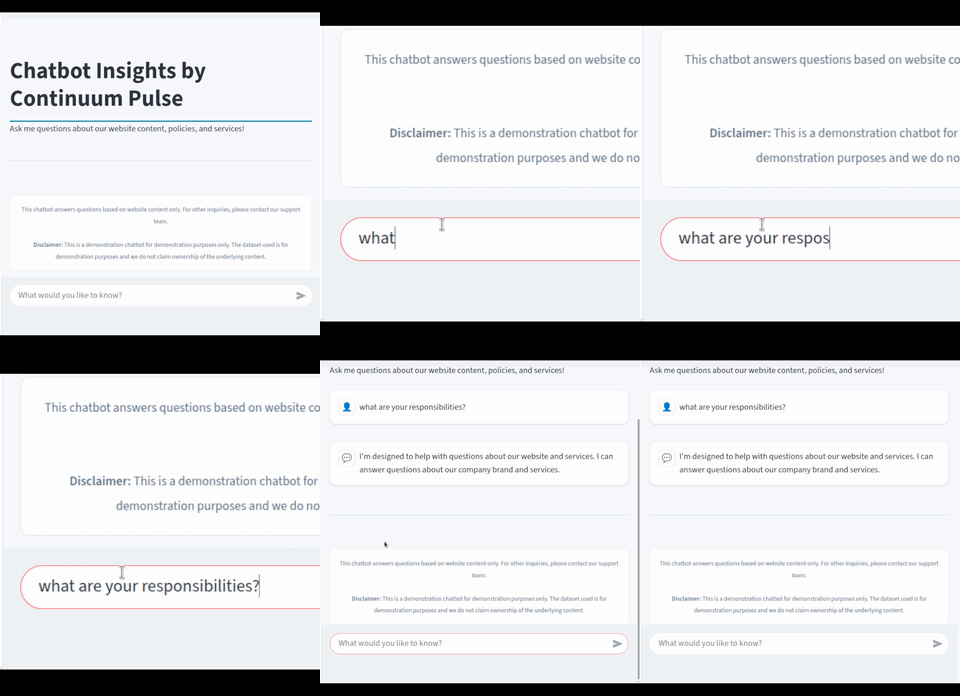
Out of scope
An example of how the system answers politely about its responsibilities.
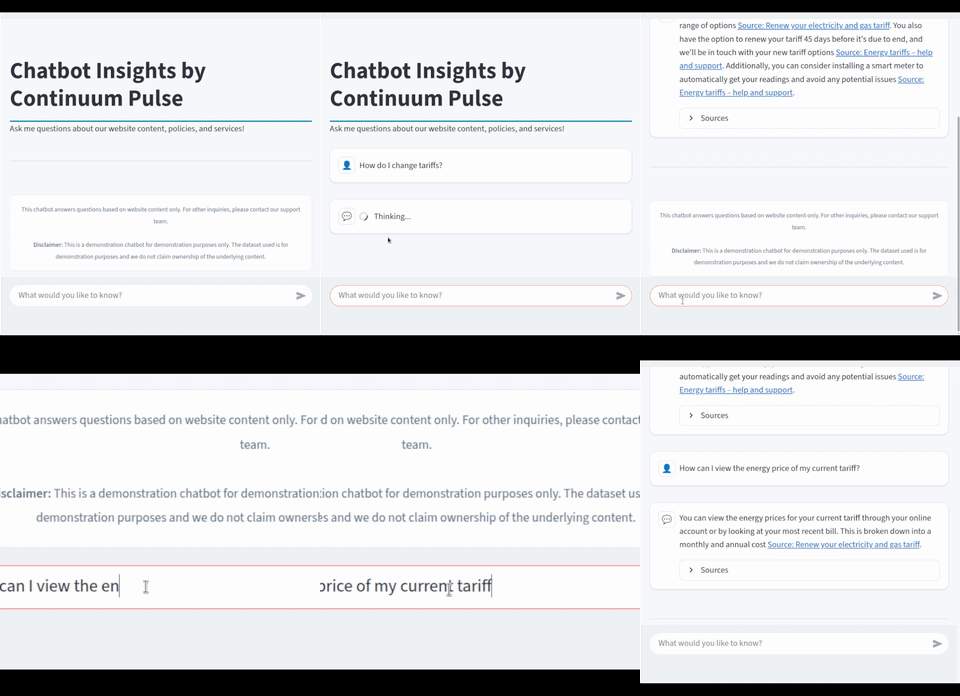
Services Details
Live demonstration of how semantic search provides in-depth information.
Conclusion
The case study demonstrates that successful conversational agent implementation requires careful balance between technical sophistication and practical business value. By focusing on streamlined proof-of-concept development and clear value definition, organizations can achieve meaningful results while managing both cost and complexity considerations effectively.